Recent Posts

Showing posts with label company. Show all posts

Monday, November 01, 2010

SEDUCTION

A few weeks ago (as I blogged earlier) I finally got to see  (and enjoyed) Leap of Faith. What I loved most though  (and what really made the show magnificent) was Raúl Esparza's electric performance.  He was amazing...no, really, AMAZING (in an I-can't-get-it-out-of-my-head-amazing way).  Sure, I have had my musicals-du-jour throughout the years, but I can't remember the last time I saw one performer make a show work.  There's nothing terribly wrong with Leap of Faith as a whole (I like it), but its because of one performer (Esparza) that the show really worked as well as it did.  During intermission and post-show, I heard audience members everywhere around me excitedly buzzing about the strength of his performance.  The positive buzz about Leap of Faith was due in large part to Esparza.

The energy he brought to the stage almost became seductive because the way Esparza (as Jonas Nightingale) lured the audience into the story as much as he did the townspeople of Sweetwater made you really want to follow, trust and believe in his character - and when it was over, he left you wanting more .   When Esparza was on that stage, his presence was strong, but when he opened up his mouth to sing?  Forget about it, he owned it.  Esparza has an effortless vocal quality that is so clear, so strong and diverse - total rocker and yet 100% legit all within seconds of each other (while acting) - which is astounding!  And even now...after two weeks have come and gone since I saw Leap of Faith I am still thinking about the way he sounded.   He is phenomenal.

Lets be honest, since I left the theatre, I have been on a Raúl Esparza music kick - I am totally obsessed with the way he sings (lets just say that right now, my neighbors probably don't appreciate Being Alive, Petrified and select songs from tick, tick...BOOM! on continuous loop).  I am in complete awe over the way he uses his voice (the effect it has on phrasing and hitting some crazy notes) and how committed he is to his performance in whatever role he's in.  The man's voice was pretty fantastic when he first burst onto the scene in tick, tick...BOOM! (off-Broadway) in 2001 and his performance as Bobby in Company changed my perspective on a show that I thought I knew well.  

Cut to the 2007 Tony Awards:


Me:  Wait, that's Raúl Esparza...as Bobby...?  He's fantastic.  When did this happen?

How could I have missed  Raúl Esparza in Company prior to the Tony Awards?  When I saw the above clip during the awards telecast, I quickly got my musical theatre priorities straightened and then had to see more of the revival of this show.

In 2008, the Broadway Revival of Company on PBS Great Performances aired and though I was expecting him (after seeing the Tony Awards)  I was almost caught off guard by the brilliance of Esparza's portrayal of Bobby.  This was the first time I had seen the show in its entirety which also explains the added perspective to Company that I gained.  Over the years,  Company has easily become one of my favorite Stephen Sondheim shows.  When I saw it on PBS Great Performances though, everything changed - I gained a new perspective on the character of Bobby (post is forthcoming) and most importantly, I was reintroduced to Raúl Esparza.

It was 2001 when I was first introduced to Esparza when I  purchased tick, tick...BOOM! - the semi-autobiographical musical about the struggle the late Jonathan Larson endured to create and make an impression on the musical theatre landscape.  Esparza played Jon in tick, tick...BOOM! and I remember wondering what it was like to play someone who had only recently (and unexpectedly) passed away and to be the first person to bring this real person (not a character) to life...in which Larson's parents, family and friends would be present.  I remember thinking that only an exceptional actor could pull that off and I admired Raúl Esparza for being able to do so.

Clearly, Esparza's voice is extraordinary and it makes you stop and listen and really believe in what he is singing about.  I think this is the case with every song I've heard him sing.  I am just so grateful to have had the opportunity to see/hear him live - what he did with every song he sang in  Leap of Faith just blew my mind.

Clearly, I'm not the only one who sees the brilliance in Raúl Esparza.  He is not only an amazing singer (as I've been rambling on about) but actor - look at the number of Tony Award nominations he's received since he made his Broadway debut in 2001 (thanks for the info, IBDb!):
  1.  Broadway Debut in The Rocky Horror Show - 2001
  2.  Tony Award nomination #1: Taboo (best featured actor in a musical) - 2004
  3.  Chitty Chitty Bang Bang - 2005
  4.  Tony Award nomination #2: Company (best actor in a musical)  - 2007
  5.  Tony Award nomination #3: The Homecoming (best featured actor in a play) - 2008
  6.  Tony Award nomination #4: Speed-the-Plow (best actor in a play) - (how did I not remember he was in THAT media debacle?). - 2009
This means that in a 5-year period (between 2004-2009), Esparza was nominated for a Tony Award in every possible category for which he was eligible.   Only Boyd Gaines (who was coincidentally the first Bobby in Company that I ever heard)  is the other actor to also have this same distinction .  If you haven't been fortunate to have seen Esparza perform, watch these and you'll see/hear what a phenomenal talent he is:


Raúl Esparza singing Lonely House at Seth's Broadway Chatterbox, 2004

Listen to the the way he sustains those notes!  Seriously?  And.  He can do Defying Gravity...and its no surprise he kills this too.


Raúl Esparza singing Defying Gravity at Seth's Broadway Chatterbox, 2004


In May 2005, Esparza appeared in the American Theatre Wing's Working in the Theatre seminar in which he said (in reference to what makes a good actor), "I don't want to put Raúl Esparza onstage, I want to put whoever that person [character] on stage is and somehow disappear..."  Sounds like a pretty obvious statement but I've been to enough shows (plays and musicals), seen plenty of TV shows or films in which that was not the case.  I have to say that when I saw Leap of Faith, I didn't necessarily feel that every actor onstage was their character, but I certainly felt so about Esparza - I feel confident in stating that I think is brilliant in pretty much anything he does.  I'm not sure where Leap of Faith will go (rumor has it Broadway-bound in Fall 2011).  If it does indeed go to Broadway, I hope that -Tony voters will see and hear just how magnificent he is as a performer and will reward him accordingly.   NY has a ton of fantastic singers/actors, I have not heard anyone who can sing a range of styles the way he can all the while being a remarkable actor to boot.   It is about time Tony voters.  All I can say is, get ready!

To Raúl Esparza, I have two words for you:  SOLO ALBUM.  Oh wait, actually there are three more words too:  CONCERT IN LA!  Ok, thanks...oh and, BRAVO!!!

Am I the only one utterly obsessed and amazed (other than Seth Rudetsky) with  Raúl Esparza's voice?  Tell me what you think: [theaterfan (at) aol (dot) com]!

Tuesday, June 12, 2007

WHAT WOULD WE DO WITHOUT YOU?

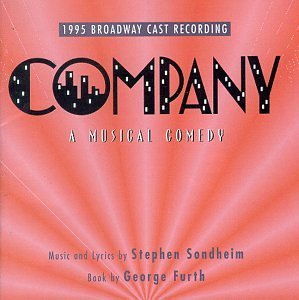
Its official, the revival of Stephen Sondheim's Company will close on Sunday, July 1. Just two days ago, Company won the Tony Award for best revival of a musical and upon closing, it will have played 34 previews and 247 regular performances at the Ethel Barrymore Theatre. Company first premiered in 1970 and was arguably a revolutionary work as it not only was one of the first musicals to deal with adult themes but is a concept musical comprised of short vignettes vs. most book musicals which follow a clearly delineated plot. Bobby, the main character is the only character who appears in each of the six vignettes and binds the story together.

What Company is not, is a two hour, optimistic, joyful, superficial musical with a happy ending. Instead, the show speaks volumes of insecurity, solitude, love, marriage (a common Sondheim topic), metropolitan living and the potential idea of uncertain sexuality. Sondheim's work is also unique in that unlike his predecessors, his music tends to comment more upon the characters (in the moment) instead of the song furthering the plot. A Sondheim song can also immediately get to the essence of a character without ever blatantly explaining its intention to their audience.

The opening sequence of Company emphasizes Bobby's position in the musical: that he is a bachelor living in Manhattan with married friends and he is alone. It emphasizes the monotonous, impersonal city life where nobody seems to directly interact with another person. Musically, the vamped slurred tenuto-stacatto form represents a busy signal which sets the tempo of the opening number. Lyrically, "phone rings/door chimes/in comes company" and the "Bobby baby/Bobby Bubbi/Roby" emphasizes this almost impersonal yet affectionate reference to Bobby while underscoring the title song. This opening mood setting number recurs again in "Another Hundred People" as the entire song is about the impersonal, urban modernism of living in Manhattan. In its own form, "Another Hundred People" connotes the difficulty of living in a "city of strangers/[who] meet at parties through the friends of friends who they never know" where you cannot easily make interpersonal relationships in an increasingly dehumanized society. It emphasizes to Bobby that everyone seems to be floating around in a lonely crowd where everyone is alone.

When Company premiered in 1970, it was an era when marriage was not necessary for either party to survive in the world. Until that time, marriage was seen as a necessity not only to procreate, but for emotional and economic reasons. Bobby represents the first of his generation who is not able to choose the expected lifestyle of someone his age. He is also very torn and confused as to what he wants which is explained in "Sorry/Grateful."

"Sorry/Grateful" is the fourth song in Company where Bobby's friends' advice and comments almost become his own thoughts. The song reflects the confusion and and reality of who Bobby is: he has problems understanding being something and becoming someone. He is very much a one dimensional character who cannot look too deeply into his own self for fear of what he will find. How can Bobby possibly become something else when he does not know what he even is? Bobby is constantly looking at his own life from afar without ever really commenting upon it.

It isn't until "Being Alive" (the show's closing number) when Bobby finally establishes a point of view and truly becomes a character vs. a narrator. Hearing Bobby finally have a point of view and this epiphany was an exciting and thrilling breakthrough (but did it happen too soon?). It was almost a relief waiting for Bobby to discover himself -- he was as much a viewer looking through the window of his life as we the audience. Having an opinion was something we as the audience desperately wanted for him. Unfortunately, Sondheim was never satisfied with the ending of Company. He saw "Being Alive" as a "cop out" to the show's finale. Initially he had written "Happily Ever After" but it was so dark and painted such a depressing stance on being alone that it was cut during its out-of-town-tryout in Boston. Directors for subsequent revivals of the musical didn't like the idea of Bobby as a one-dimensional character through 95% of the show either, so the once axed song "Marry Me A Little" was re-inserted to the end of Act I in an attempt to make Bobby a little more humane.

As times changed, producers, directors and critics chose to view Company and more specifically, the character of Bobby to possibly reflect homosexuality -- a topic that was more openly discussed. There has been great debate over the years as to whether its appropriate to inject a gay sensibility into the show. If one were to look hard enough, there might be some homosexual overtones or a confusion of sexual identity, but in what aspects? Bobby can't fall in love (or commit seriously to any woman), can't reconcile what he wants emotionally from life, but that I think is digging rather deep to see some kind of homosexual overtone. In 1970, it might have been more unusual to see a single 35 year old of either gender, but post 1990, is that so unusual? For the record, Sondheim has claimed that he never wrote Bobby as a gay character.


To claim that Company is multi-dimensional is probably an understatement. It also proves that it truly was a ground-breaking musical in its time. Back in "the day" (the 1970s) Company offered something new (structurally and stylistically) to theatre going audiences which made musical theatre more intriguing. Company holds a special place in my heart as it was one of the first Sondheim shows that was so compelling to me that learning as much as I could about the show (and Sondheim) wasn't good enough. Company has some obvious meat that makes deconstructing both music and lyrics thoroughly riveting to any Sondheim aficionado.

* * *

As I was inspired to write about Company, one of my favorite musicals, I found myself referring to a paper I wrote in college of the "Evolution of the Sondheim Style"...a good deal of this post comes from said paper, nonetheless a very helpful device for me. :)

Monday, January 30, 2006

BEING ALIVE

In college, I took an independent studies class in which one of my favorite professors and I discussed the work of Stephen Sondheim. It was a 20-something page paper analyzing the choices and themes in 3 of Sondheim's musicals (my favorites): Company (1970), Passion (1994) and (I believe) A Little Night Music (1973). Without getting into exhaustive detail (and because I don't have my paper on hand to reference), one of the songs that my professor and I discussed was Being Alive from Company. In order to really understand the show & the song, one needs to know what it's about (and that is a whole post & conversation in and of itself). Company provides an honest, witty, sophisticated look at relationships from the point of view of Robert, who contemplates his single-life compared to that of his various married friends. He weighs the pros & cons of being alone to that of his friends and in the end begins to understand what he wants from his own life which he sings about in Being Alive.

While I have another blog that only houses lyrics that have either meant something to me or I've wanted people to discover, I'm posting the Being Alive lyrics here. With Valentine's Day coming up, I've had many conversations these days with friends about what they want and fear from life. I think more than a few people can relate...there was a point in my life not too long ago when this song was more than just a set of lyrics to me.

* * *

BEING ALIVE
~Sondheim

Someone to need you too much,
Someone to know you too well,
Someone to pull you up short
And put you through hell.

Someone you have to let in,
Someone whose feelings you spare,
Someone who, like it or not,
Will want you to share
A little, a lot.

Someone to crowd you with love,
Someone to force you to care,
Someone to make you come through,
Who'll always be there,
As frightened as you
Of being alive,
Being alive,
Being alive,
Being alive.

Somebody, hold me too close,
Somebody, hurt me too deep,
Somebody, sit in my chair
And ruin my sleep
And make me aware
Of being alive,
Being alive.

Somebody, need me too much,
Somebody, know me too well,
Somebody, pull me up short
And put me through hell
And give me support
For being alive,
Make me alive.

Make me confused,
Mock me with praise,
Let me be used,
Vary my days.
But alone is alone, not alive.

Somebody, crowd me with love,
Somebody, force me to care,
Somebody, make me come through,
I'll always be there,
As frightened as you,
To help us survive
Being alive,
Being alive,
Being alive!
Related Posts with Thumbnails